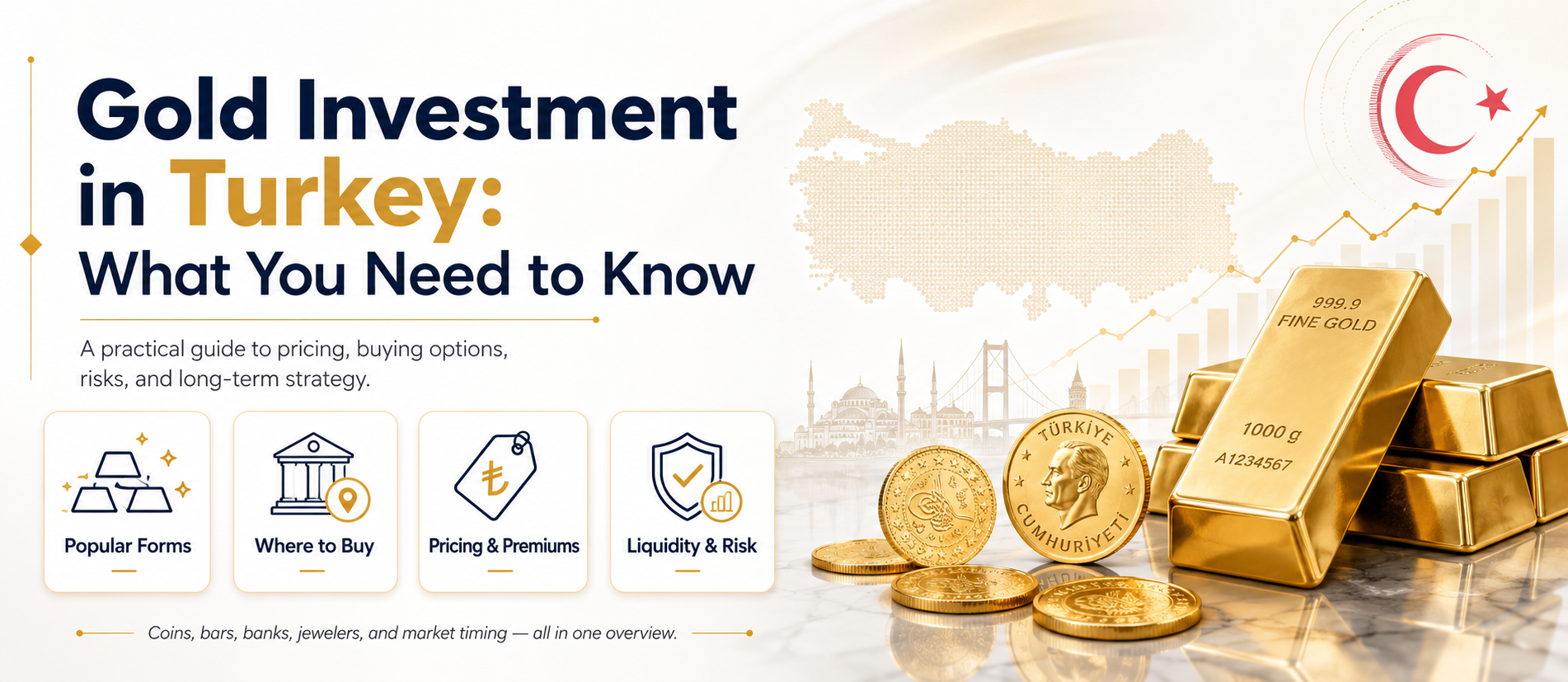
Gold Investment in Turkey: What You Need to Know (2026 Guide)
Gold Investment in Turkey: What You Need to Know (2026 Guide)
Turkey has one of the most unique relationships with gold of any country in the world. It is not just an investment here — it is a cultural institution. Understanding how gold works in Turkey gives you a real edge, whether you are an expat living here, a foreign investor watching the lira, or simply curious about one of the world's most gold-obsessed nations.
This guide covers everything: how to buy gold, which form makes sense, what the new 2026 rules mean for you, and how gram gold has performed against TL depreciation.
Why Gold Matters So Much in Turkey
Turkish households privately hold an estimated 3,000–5,000 tonnes of gold — worth hundreds of billions of dollars. There is even a local term for it: yastık altı (under the pillow), referring to gold stored at home rather than in a bank.
This isn't mere tradition. It is a rational response to decades of currency volatility. When the lira loses value — and it has lost value every single year against the dollar for the past decade — gold held in grams of TRY has consistently protected purchasing power. For Turkish savers, gold is the most accessible and trusted inflation hedge available.
How Gold Is Priced in Turkey
Gold in Turkey is priced in Turkish Lira per gram, not per ounce as in international markets. This means the TRY price of gram gold moves based on two factors simultaneously:
- International spot price (USD per ounce)
- USD/TRY exchange rate
This double exposure is actually what makes Turkish gram gold such a powerful hedge. Even if international gold prices stay flat, a weakening lira pushes the TRY gram price higher. As of early June 2026, gram gold (24K) is trading around 6,550–6,650 TL per gram, while the 52-week range has been 4,150 to 7,811 TL — reflecting both global gold moves and lira depreciation.
Ways to Buy Gold in Turkey
1. Physical Gold — Kuyumcu (Jeweller)
The most traditional route. Every Turkish neighbourhood has a kuyumcu (gold dealer/jeweller). You can walk in, pay cash or card, and walk out with physical gold in hand.
What to buy:
- Gram gold bars (has/külçe altın) — 1g, 2.5g, 5g, 10g, 50g, 100g sizes. Easiest to buy and sell, closest to spot price.
- Çeyrek altın (quarter coin) — the most popular form. About 1.75g of 22K gold. Buying and selling spread is typically around 1.5%, making it very liquid.
- Yarım altın (half coin) and Tam altın (full coin) — larger denominations of the same coin format.
- Cumhuriyet altını — the classic Turkish Republic gold coin. Carries a slight premium but highly trusted.
Important: Always ask for a receipt (fatura). As of 2026, new regulations require documented transactions for all gold purchases (see below).
2. Gold Bank Account (Altın Hesabı)
Most Turkish banks offer gold savings accounts where you hold gold in grams rather than cash. You can open one with as little as 1 gram.
How it works:
- You deposit TRY, which is converted to grams of gold at the current rate
- Your balance is shown in grams, not lira
- You can convert back to TRY at any time at the current rate
- Some banks offer a small interest on the gram balance (typically 0.5–1% annually)
Advantages: No storage risk, no physical handling, easy to track on mobile banking, TMSF-insured up to 250,000 TRY equivalent.
Disadvantages: Small spread on buy/sell, you don't physically hold the gold.
3. Gold at the Istanbul Stock Exchange (Borsa İstanbul)
For larger investors, gold can be traded on the Istanbul Stock Exchange through licensed brokers. This offers tighter spreads and more liquidity but requires a brokerage account.
4. Gold Investment Funds (TEFAS)
Gold-backed mutual funds are available through TEFAS (Turkey's fund platform). These track gold prices and are accessible through most banks and investment apps with very low minimum investment amounts.
New 2026 Regulations: What Changed
Turkey introduced significant new rules for gold trading in 2026 that every buyer needs to know:
Cash ban on gold transactions: All gold purchases and sales must now be settled through bank payment. Cash transactions for gold are prohibited. This applies to kuyumcu shops as well.
Traceability requirements: Every gold transaction must be documented and traceable. Receipts are mandatory.
Why this matters for you: If you are buying physical gold, bring your ID and expect to pay by card or bank transfer. Sellers who offer cash-only deals are operating outside the law — avoid them.
The goal of these regulations is to bring Turkey's vast informal gold market into the formal economy. For legitimate investors, this actually improves market stability and reduces counterparty risk.
Gold vs. TL Depreciation: The Numbers
This is the core question for any Turkey-based investor. Has gram gold actually protected against lira weakness?
PeriodTL Depreciation vs USDGram Gold TRY Return2023~%40~%452024~%20~%252025~%20~%18–22
The pattern is consistent: gram gold in TRY terms has closely tracked or slightly exceeded lira depreciation over multi-year periods. It is not a guaranteed profit tool — there are years where it lags — but as a store of value against currency risk, the historical record in Turkey is strong.
Gold vs. Other Investment Options in Turkey
OptionInflation HedgeCurrency HedgeLiquidityRisk LevelGram Gold✅ Strong✅ StrongHighMediumTL Time Deposit✅ Moderate (currently)❌ NoneMediumLowUSD Account❌ Indirect✅ StrongHighLow-MediumReal Estate✅ Strong✅ ModerateLowMedium-HighStocks (BIST)✅ Variable✅ PartialHighHigh
Gold's strength is that it hedges both inflation and currency risk simultaneously. This is why it remains a cornerstone of Turkish household savings regardless of economic cycles.
Practical Tips for Buying Gold in Turkey
Start with a gold bank account if you are new. It is the easiest entry point — no storage concerns, fully digital, and you can start with small amounts.
For physical gold, stick to established kuyumcu shops. Look for shops that are members of the Istanbul Jewellers Association (İstanbul Kuyumcular Odası). Avoid street vendors or informal sellers.
Track the spread. The difference between the buying and selling price varies between dealers. For standard coins like the Çeyrek, the spread is typically around 1.5%. For smaller gram bars, it can be higher. Always check before buying.
Monitor both the international gold price and USD/TRY. Since Turkish gram gold is driven by both factors, you need to watch both. GetKur shows real-time gram gold prices alongside live exchange rates — making it easy to track both drivers in one place.
Don't try to time the market short-term. Gold is a long-term store of value tool in the Turkish context, not a trading instrument. Most experienced Turkish investors hold gold as a permanent portion of their savings, not as a speculative trade.
How Much of Your Savings Should Be in Gold?
There is no universal answer, but a common approach among Turkish financial advisors is the 30-30-30-10 rule for TRY-based savers:
- 30% in TL time deposits (for guaranteed real returns while rates are high)
- 30% in gold (long-term store of value)
- 30% in foreign currency (USD/EUR)
- 10% in other assets (stocks, funds, etc.)
The exact split depends on your time horizon, risk tolerance, and views on future lira movement. The key principle is diversification across these three core Turkish savings instruments.
Summary
Gold in Turkey is not a niche investment — it is the country's most trusted savings vehicle, with deep cultural roots and a strong historical track record as a hedge against lira depreciation. Whether you choose physical coins from a kuyumcu, a digital gold account at your bank, or a gold fund through TEFAS, the entry point has never been more accessible.
With new 2026 regulations bringing the market more transparency and the lira continuing its controlled depreciation path, gold remains one of the most rational and liquid options for protecting purchasing power in Turkey.
This content is for informational purposes only and does not constitute investment advice. For real-time gram gold prices and live exchange rates, visit getkur.com.