
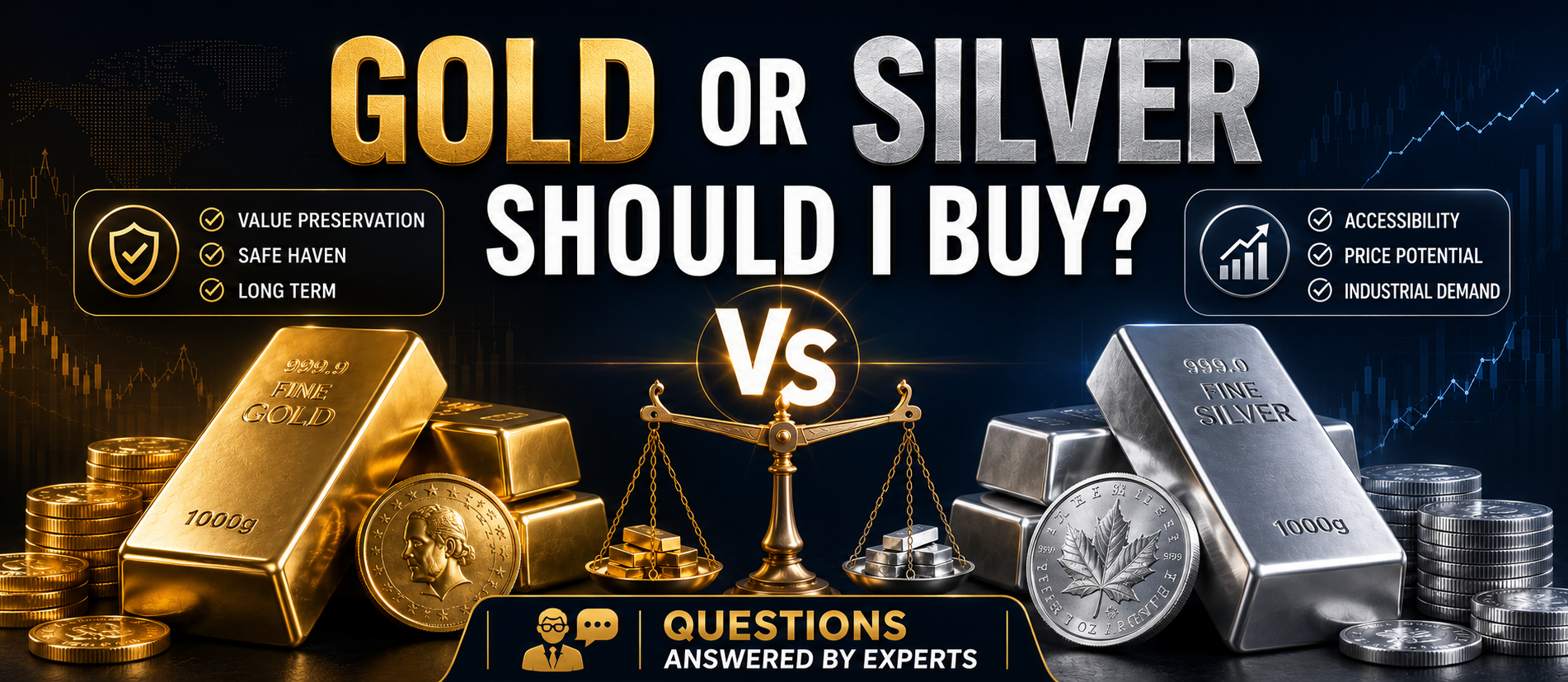
Gold or Silver? Experts Answer the Questions Every Investor Asks
Introduction: You're Asking the Wrong Question (And That's Okay)
When most people ask "should I buy gold or silver?", what they really mean is: which one will make me more money?
No one can answer that with certainty. But here's what we can tell you: gold and silver are not rivals — they complement each other. Which one suits you depends entirely on your goals, your budget, and how much risk you're comfortable with.
This guide will help you figure that out.
The Core Difference: Gold Protects, Silver Grows
Gold and silver are both precious metals, but they play very different roles in the investment world.
Gold is primarily a store of value. Central banks hold it. Investors flock to it during crises. Its price is driven not by industrial demand, but by global uncertainty, inflation fears, and monetary policy. That's why gold tends to move slowly but steadily — it's the anchor of a precious metals portfolio.
Silver, on the other hand, is both an investment asset and an industrial commodity. It's used in electronics, solar panels, medical devices, and more. This industrial dimension makes silver unique: when economies grow, silver demand rises; when they contract, it falls. The result is that silver is more volatile — it moves faster and harder in both directions.
In short: gold protects your wealth. Silver can grow it — but it can also shrink it faster.
The Gold/Silver Ratio: A Simple Tool Most Investors Overlook
Experienced investors often track the Gold/Silver Ratio — the number of silver ounces it takes to buy one ounce of gold.
Its long-term historical average sits around 60–70. During the 2020 pandemic, the ratio spiked to 120, meaning silver had become historically cheap relative to gold. Silver then surged sharply, and the ratio normalized.
How to use it practically:
- Ratio above 90: Silver is historically cheap — may be a buying opportunity
- Ratio below 50: Silver is expensive relative to gold — gold looks more attractive
Tracking this ratio gives you a rational framework for deciding which metal to favor at any given time, rather than guessing.
Which Metal Shines When?
Gold tends to outperform during:
- Geopolitical crises and wars
- High inflation and currency devaluation periods
- Central bank reserve accumulation cycles
- Interest rate cut expectations
Silver tends to outperform during:
- Economic expansion and industrial growth
- Green energy investment booms (solar panel demand)
- "Catch-up" rallies after gold has already risen
- Periods when the gold/silver ratio is historically elevated
Important: these cycles can't be predicted in advance. But understanding them helps you position yourself more thoughtfully.
Choosing Based on Your Risk Profile
Conservative investor → Gold
If your goal is to protect your savings — to hedge against inflation, currency weakness, or economic instability — gold is the more suitable choice. Price swings are more limited, long-term value loss is rare, and liquidity is high.
Growth-oriented investor → Silver
If you're aiming for higher returns and are comfortable with short-to-medium-term volatility, silver may appeal to you. Just remember: the same volatility that drives silver up can drive it down just as fast.
Balanced investor → Both
Many experts recommend structuring a precious metals portfolio as 70–80% gold / 20–30% silver. This combination provides stability while capturing silver's upside potential.
A Note for Investors Interested in Turkey and Emerging Markets
Turkey offers an interesting case study for precious metal investors. With persistently high inflation and a currency that has lost significant value against the dollar over the past decade, Turkish investors have long used gold and silver not just as growth assets — but as a primary defense against currency erosion.
When the Turkish Lira weakens against the US dollar, TRY-denominated gold and silver prices rise accordingly. This means owning precious metals in Turkey provides a double layer of protection: the metal's own value, plus the currency hedge.
Silver is particularly interesting in this context. Because it's far cheaper per gram than gold, it allows investors with smaller budgets to start building a position. In Turkey, you can begin investing in silver with just a few hundred Turkish Lira — making it one of the most accessible entry points into hard asset investing.
If you're tracking prices in real time, GetKur provides live gold and silver rates in both USD and TRY.
Frequently Asked Questions
I'm a beginner — which should I buy first? Start with gold. It's more stable, highly liquid, and easier to manage psychologically. If your budget is tight, silver is also a sensible starting point given its lower price per gram.
Which one delivers better short-term returns? Silver can deliver higher short-term gains — but it can also lose value faster. Short-term prediction is difficult for both metals. Don't chase recent performance.
Which is the better hedge against inflation? Historically, gold has been the more reliable inflation hedge over the long term. It has preserved purchasing power across centuries and economic cycles.
Does it make sense to hold both? Yes — and most experts recommend it. Gold's stability combined with silver's growth potential creates a more balanced exposure to the precious metals market.
When should I sell? There's no universal answer. A common approach: sell gradually when you need the funds, or when one metal has grown to represent a larger share of your portfolio than you intended.
Bottom Line
Gold or silver? The honest answer is: it depends.
If you want stability and long-term protection → Gold If you want growth potential at a lower entry price → Silver If you want the best of both → Hold both, in a balanced ratio
Both metals have proven their value over centuries as stores of wealth, inflation hedges, and safe havens in uncertain times. Whichever you choose, consistency and patience will serve you better than trying to time the market.